I Gave My Last $10 to a Homeless Man in 1998 — Today a Lawyer Walked In With a Box
In this story
A single mother gave her last $10 to a homeless man on a rainy night in 1998. Twenty-seven years later, a lawyer walked into her office with a box.
In this story
I GAVE MY LAST $10 TO A HOMELESS MAN IN 1998, AND TODAY A LAWYER WALKED INTO MY OFFICE WITH A BOX — I BURST INTO TEARS THE MOMENT I OPENED IT.
The Night I Gave My Last to a Homeless Man
I was 17 when I had my twins.
Seventeen, broke, exhausted, and still an honor student, because I believed that if I worked hard enough, life would eventually give me a chance.
My parents didn’t. Instead, they said I had ruined everything and cut me off completely. No help. No home.
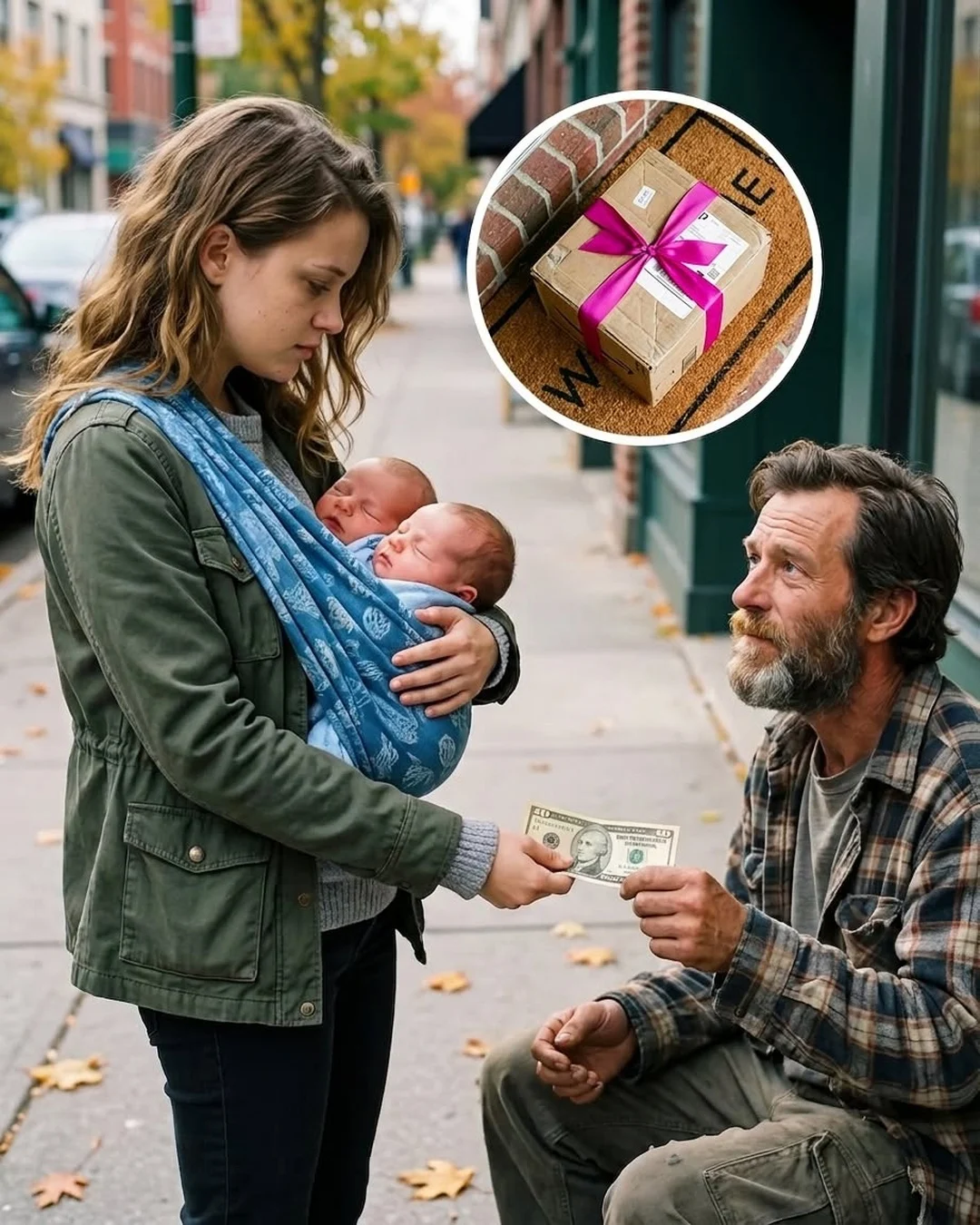
So by November 1998, I was a student and a mother of two babies, Lily and Mae. I carried them in a worn sling against my chest, and I survived on instant noodles and night shifts at the university library.
That night, it was pouring in Seattle. I had exactly $10 left. It was bus fare, bread and three days of survival.
Then I saw him.
Across the street, an older man sat under a rusted awning, soaked through and shaking so badly it hurt to watch. He didn’t ask for anything. Instead, he was just invisible.
Suddenly, I knew that feeling.
Without thinking, I pressed my last $10 into his hand. “Please… get something warm,” I whispered.
He looked at me, really looked. For some reason, I asked, “What’s your name?”
There was a pause. Then, quietly, he said, “Arthur.”
I told him my name was Nora and introduced my girls. He repeated my name once, as if he didn’t want to forget it.
I walked home three miles in the rain, holding my babies close. When I got inside, I stared at my empty wallet and thought I was stupid. I told myself I couldn’t afford kindness.
Twenty-Seven Years Later, a Man in a Charcoal Suit
Over the next years, I worked afternoons at a diner and nights at the library. A neighbor, Mrs. Greene, watched the girls during my shifts and refused to take a dime. “You finish school,” she told me. “That’s enough.”
So I did, one class at a time. Meanwhile, the girls grew up in one small apartment after another.
Then twenty-seven years passed, and I’m 44 now. My girls are grown, but life didn’t get easier. Two years ago, Mae got seriously ill. Doctor visits turned into procedures, and procedures turned into bills that never stopped. I was drowning again.
This morning, I sat at my desk, staring at another overdue notice. Then the door opened, and a man in a charcoal suit walked toward my cubicle.
“Are you Nora?” he asked.
“Yes,” I answered warily.
He placed a small, worn box on my desk. “My name is Carter,” he said. “I represent the estate of Arthur.”
The name hit me instantly, because he was the man I had met for thirty seconds in 1998.
“He spent years trying to find you,” Carter said. “He asked me to give this to you personally.”
My hands shook as I opened the box.
Inside the Box: What the Homeless Man Left Behind
Inside lay a worn leather notebook. The first page stopped me cold.
“Nov. 12, 1998 — Girl named Nora. Two babies. Gave me $10. Don’t forget this.”
I pressed my hand to my mouth and turned the page. There were entries about other people and other years, but my name appeared more than any other.
“Never forget Nora with the two babies.”
“Must find Nora with the girls.”
“I hope Nora and her kids are safe.”
“Arthur kept that notebook for over 30 years,” Carter said. “He didn’t track money. He tracked people and the moments that mattered.”
After that, he told me who Arthur really was. Arthur hadn’t always lived on the street. He once ran a small machining business, but when it failed, he lost everything, and he had no family to fall back on. According to Carter, meeting me changed him, because it was the first time in years that someone treated him as if he mattered.
From there, Arthur rebuilt his life slowly. He took maintenance jobs and cleaning work, lived simply and saved what he could. Eventually, he qualified for housing and a small apartment. Every year on the same date, he wrote the same line: “Still looking for Nora.”
The Check That Changed Everything
“But how did you find me?” I asked.
The answer was the fundraiser I had posted for Mae’s treatment. I had barely raised a couple of dollars. Still, Arthur saw it. He recognized my name and my daughters in the photo. His health was already failing, so he made a will instead.
“Take another look inside,” Carter said.
Beneath the notebook lay a cashier’s check. Then my eyes locked onto the number: $62,000.
“This isn’t—” I began, still shaking.
“It is,” Carter said gently. “Every dollar he saved, plus the rest I recovered from the pension from his old business. He wanted this to go to you, with no conditions.”
“But why?” I asked.
“He said it was never his money. Arthur believed it belonged to the moment that changed his life.”
I burst into tears. It wasn’t because of the amount, but because that $10, the one I thought I couldn’t afford to give, hadn’t disappeared. It had stayed with Arthur for almost three decades.
“I only spoke to him for less than a minute,” I said.
Carter gave a small nod. “Sometimes that’s enough.”
What Nora Did Next
That night, I slid the check across the table to Lily, and I told my girls everything. When I finished, Mae whispered, “All this… from a mere $10?”
“No,” I said. “From being seen.”
In the following weeks, I finally paid off the medical debt and watched the numbers fall to zero instead of climbing. Mae’s treatments continued, but now there was room to breathe.
Then I went looking for Mrs. Greene. I sat in her small living room, told her everything and set an envelope on the table. “I never paid you back,” I said. She told me, “You kept going. That’s what matters.” After a moment, she took the envelope.
At home, I opened Arthur’s notebook to a blank page and started my own list. The first line read: “April 3 — Paid Mrs. Greene back for babysitting the twins so I could finish school.”
Over the following months, I still added small things. I covered someone’s bus fare, helped a coworker who was behind on rent and dropped off groceries for a neighbor. I told no one.
A week later, I drove to a quiet cemetery and found Arthur’s marker. I placed a ten-dollar bill at the base of the stone.
For years, I believed I couldn’t afford kindness. I was wrong, because kindness doesn’t disappear. It waits, and when it comes back, it changes everything.
If you want to help someone in your own community, the National Coalition for the Homeless lists ways to get involved.
Related: He Wore a Bright Red Dress to Graduation While 600 People Laughed