A Dad Labeled His Twins With Letters. They Shaved Them Away
In this story
This family story follows a father and his identical twin sons. It is a story, not a news investigation. Still, the ending has stayed with many readers.
In this story
The boys were four years old, and their names were Max and Leo. To strangers, they looked almost the same. To their mother, Emma, they were never hard to tell apart.
Their father, Henry, loved them without question. Even so, he often mixed up their names. That private worry led him to a drastic haircut. Later, it led to a night he would not forget.
He thought giant letters would end the mix-ups
Henry could not always tell Max from Leo. Emma usually spotted the difference in a second.
Max was the quieter boy, and at night he curled around a worn green dinosaur. Leo rushed into every game and filled every quiet moment.
Emma saw all of that, and Henry noticed many of those habits too. But when the boys stood still and silent, his certainty faded. Then shame crept in, because he believed a father should never have to guess.
So one afternoon, Emma went out for groceries. Henry remained at home with the identical twin sons. He buzzed their curls close, then left a large M on one head and a large L on the other.
Emma walked into a house full of letters
The identical twin sons ran to meet her at the door and shouted the letters with delight. She set the bags down and stared. Their soft hair was gone. In its place were two huge marks, and her children looked like walking name tags.
She was furious.
You turned their heads into labels. You did not even ask.
Henry tried to keep the mood light, and the boys hopped and pointed at their scalps. Emma would not have the full fight in front of them, so she told Henry they would talk later.
That evening, the letters were all the twins wanted to discuss. Emma put them to bed in their usual places, and then the house grew quiet.
What the baby monitor showed after bedtime
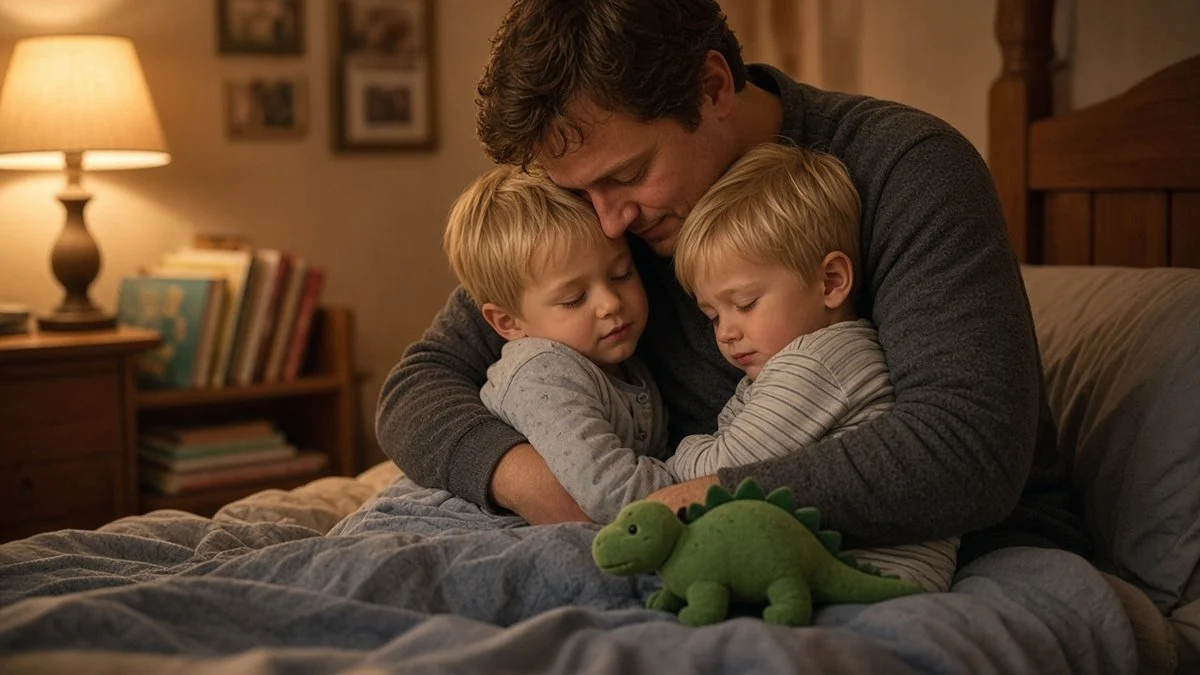
Around half past eleven, Emma glanced at the monitor. Both boys had been asleep. Then Leo slipped out of bed and woke his brother. They whispered, and Max grabbed his dinosaur and his blanket. After that, they traded beds.
At first, Emma thought it was another identity game. Some couples even talk about separate rooms to protect their sleep. That night, though, the screen showed something she could not ignore.
Leo looked toward the camera and made a hushing sound. Then the bedroom door opened. Henry stepped inside, and he was holding the clippers. Emma got up at once and hurried upstairs.
The letters were already gone
Henry stood between the two beds. The twins were wide awake and grinning, and they had also switched places. Emma asked what he was doing, and he almost dropped the tool in his hand.
“They switched,” he said.
She could already see the beds, but he meant the letters. Max pointed to his scalp, where the M was nearly gone. Leo’s L had vanished too. Those bold shapes from that afternoon were now uneven patches.
Emma thought Henry had cut their hair again, but he said he had not. Leo answered with pride: they had done it themselves after finding the clippers on the bathroom counter.
Emma’s anger swung toward the danger, because the boys were only four. Henry said he had only picked the clippers up from the floor. Instead of laughing, she banned any more cutting that night.
Then Leo said something that stopped her cold.
“We had to.”
Why the identical twin sons erased the letters
“Because Daddy was sad,” Leo told her.
Henry’s face changed. The boys had overheard him that afternoon. After Emma left for the store, he had called his brother. Then Henry told the truth.
He hated that he could not always tell his own children apart. Their habits were clear to him. But when they stood together without a word, he sometimes could not be sure. He was their father, he said, and a father should know. Out loud, he had even wondered whether he was simply a bad dad.
The boys had been in the hallway, so they had heard every word. Max whispered that phrase back to him now. Henry dropped beside the bed at once and told them that was not what he meant. He had spoken carelessly because he was upset. Then he admitted he had made the letters for the same reason.
At first the twins had liked the new look. Then they heard their father talk as if he needed those marks to get them right. So they decided the letters had to disappear. That is why the identical twin sons had picked up the clippers.
Leo said it in the plainest way.
Daddy already knows us.
The dinosaur that gave Max away
Max slipped down from the mattress and faced his father. His hair was a mess of short patches, and he was also wearing his brother’s pajamas. Then he asked the question that had followed his father for years.
“Who am I?”
Henry looked at him for a long second. Then he said, “Max.”
The boy beamed and asked how he knew, and Henry pointed at the toy in his hands. Max was holding the green dinosaur. After they swapped places, Henry named Leo, because Leo had reached for his ear.
For the first time that day, Henry laughed without shame, because he was no longer sitting a test.
Emma watched his face soften and apologized for all the old jokes. Those mix-ups had felt like comedy to her, and she had missed the hurt underneath. Henry said he should have told her, and she agreed.
Before they left the room, Max offered his father a kinder rule.
If you mix us up, that is okay.
Leo added that even they mixed themselves up in old photos. Then Henry wished them good night.
Why this story matters
In the days that followed, Emma understood the haircut differently. At first she had seen it as a lazy shortcut. In truth, Henry was afraid of failing his identical twin sons. So he tried to fix a feeling with a machine.
The twins had grasped a wiser point first. A parent does not have to pass a lineup test every hour. Instead, a parent has to know the child. A letter can mark a name. Yet it cannot remember a favorite cup, a hated fruit, or a toy that must come to bed.
Pediatric groups make a similar case in calmer words. On its HealthyChildren site, the American Academy of Pediatrics writes about twin identity. It urges families to treat twins as two distinct children, not as a matched set.
Henry still slips sometimes, and Emma does too. They no longer turn those slips into a punchline. Now their parents watch for small signs instead of obvious marks. They notice how a child enters a room, and what he refuses to put down at night.
That is the part that stays with people. The identical twin sons did not need their heads labeled. They needed their father to trust what he already knew.
Other Human Stories on this site also linger on family memory. One recent piece follows Patricia Heaton as she looks back on an unexpected early chapter of her life.