Stephen Hawking on God: What the Famous Physicist Said Happens After We Die
In this story
What did Stephen Hawking on God and the afterlife actually say? Interviewers asked the famous physicist about faith many times during his life. His answers were short and clear. He did not believe in God, and he did not think anything waits for us after death. Still, he believed we can live on in another way. Here is what he said, in his own words.
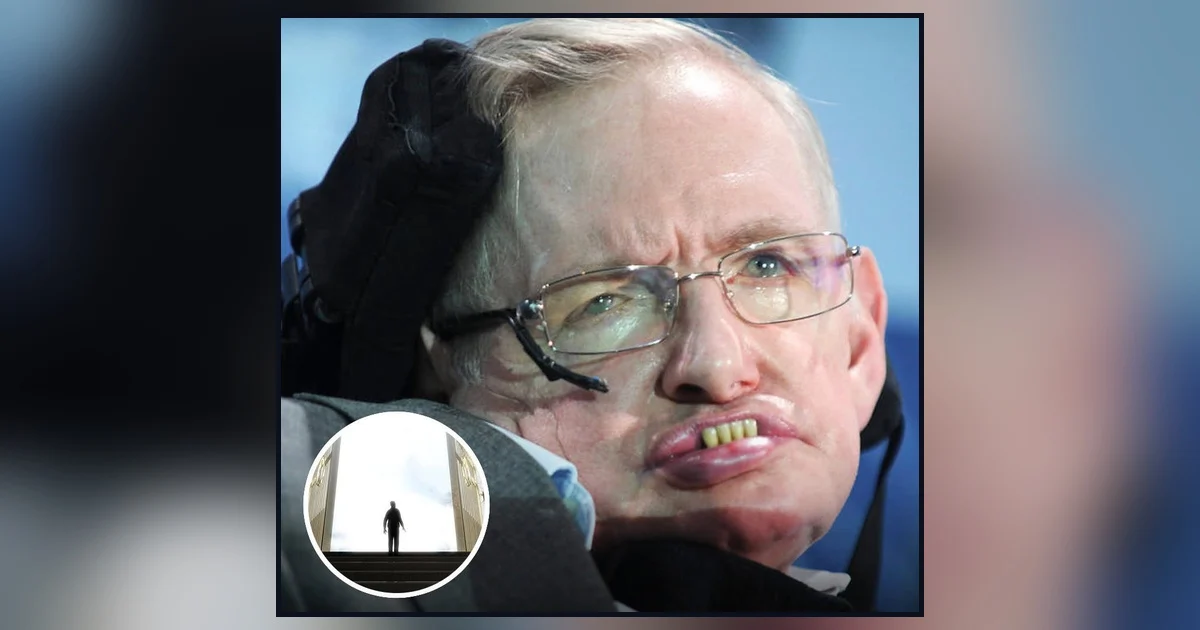
The Man Behind the Answer
Hawking came into the world in Oxford, England, on January 8, 1942. At 21, doctors told him he had motor neurone disease, also known as ALS. At the time, they expected him to live only a few more years. Instead, he lived for more than five decades after his diagnosis.
During that time, he became one of the best-known scientists in the world. For 30 years, he held the Lucasian Professorship of Mathematics at Cambridge, a post Isaac Newton once held. He also changed how scientists think about black holes. Later, his 1988 book, “A Brief History of Time,” sold millions of copies and made him a household name. He died on March 14, 2018, at age 76.
Stephen Hawking on God and “the Mind of God”
Many readers first met the topic of Stephen Hawking on God through one line in “A Brief History of Time.” In it, Hawking wrote that a complete theory of the universe “would be the ultimate triumph of human reason – for then we should know the mind of God.” As a result, some people believed he had faith.
However, he later explained that he meant it only as a figure of speech. In a 2014 interview with the Spanish newspaper El Mundo, he gave his simple answer: “What I meant by ‘we would know the mind of God’ is, we would know everything that God would know, if there were a God, which there isn’t. I’m an atheist.”
Before that, in his 2010 book “The Grand Design,” he argued that physics can explain how the universe began. “Spontaneous creation is the reason there is something rather than nothing, why the universe exists, why we exist,” he wrote. “It is not necessary to invoke God to light the blue touch paper and set the universe going.”
Stephen Hawking on God, Heaven and Death
Hawking lived with the threat of an early death for most of his adult life. Even so, he told The Guardian in 2011 that it did not scare him. “I have lived with the prospect of an early death for the last 49 years. I’m not afraid of death, but I’m in no hurry to die. I have so much I want to do first,” he said.
Then he added the line that is still quoted today. “I regard the brain as a computer which will stop working when its components fail,” he said. “There is no heaven or afterlife for broken down computers; that is a fairy story for people afraid of the dark.”
In the same interview, a reader asked him how we should live. His reply was just as short: “We should seek the greatest value of our action.”
Stephen Hawking on God in His Final Book
Hawking’s last book, “Brief Answers to the Big Questions,” came out in October 2018, months after he died. Its first chapter asks, “Is there a God?” Some viral posts quote him as saying, “There is no God. No one directs the universe.” In fact, his full wording was a little softer, according to Yahoo News UK.
“We are each free to believe what we want, and it’s my view that the simplest explanation is that there is no God,” he wrote. “No one created the universe and no one directs our fate. This leads me to a profound realisation: there is probably no heaven and afterlife either. I think belief in the afterlife is just wishful thinking.”
He also wrote about his own disability. “For centuries, it was believed that disabled people like me were living under a curse that was inflicted by God,” he said. “Well, I suppose it’s possible that I’ve upset someone up there, but I prefer to think that everything can be explained another way, by the laws of nature.”
How Stephen Hawking Said We Live On
Despite the blunt words of Stephen Hawking on God, he did not see death as the end of everything. “I think that when we die we return to dust,” he wrote. “But there is a sense we live on, in our influence, and in the genes we pass to our children.”
In other words, he believed this one life is what we have. So, in a 2011 Discovery Channel program, he said: “We have this one life to appreciate the grand design of the universe, and for that, I am extremely grateful.” Of course, readers are free to agree or disagree. After all, Hawking himself said each of us is free to believe what we want.
This story draws on Hawking’s books and on interviews reported by The Guardian, El Mundo and Yahoo News UK.